UCHI
UCHI is a web application that guides first-time homeowners through home maintenance. UCHI was created as a capstone project at the University of Washington School of Information and was completed by an international group of 4 undergraduate students.
Duration
2022 January–May
Capstone (卒業プロジェクト)
University of Washington, Information School
Services
#
UX Research
#
UX Design
#
End-to-End Design & Development
Challenge
Two-thirds of first-time homeowners experience buyer's regret, with surprise maintenance costs as the leading cause — despite home maintenance being covered in standard homebuyer education. The core problem isn't awareness; it's that every home is different, and no generic checklist holds up in practice.
How might we enable first-time homeowners in the US to learn about and organize home maintenance tasks so they can protect their investments and better care for their homes?


Click images to enlarge. (Left) Stages leading to homeownership. (Middle) Home Features in UCHI are users' unique appliances and parts of their home requiring regular maintenance. (Right) UCHI's Tasks teach homeowners how to care for their Home Features.
Process
Research
Mapping the homeownership journey revealed that post-purchase resources are the most underdeveloped stage. We spoke with 15 individuals — first-time homeowners, experienced homeowners, and real estate agents — and surveyed 40 more, then narrowed our focus to home maintenance guidance as the highest-impact gap.
A competitor analysis of two existing apps showed where current solutions fell short of user needs. From there, we built a persona aggregated from our first-time homeowner interviews and defined three pillars for the product: customizability, a task tracker, and education.
Solution
UCHI organizes a home into spaces (rooms and areas) and home features (appliances and parts of the home that need upkeep). Each home feature carries a tailored set of maintenance tasks — informed by the feature's type, age, and any additional details the user provides. The key design challenge was surfacing personalized guidance without placing the burden of input on the user.
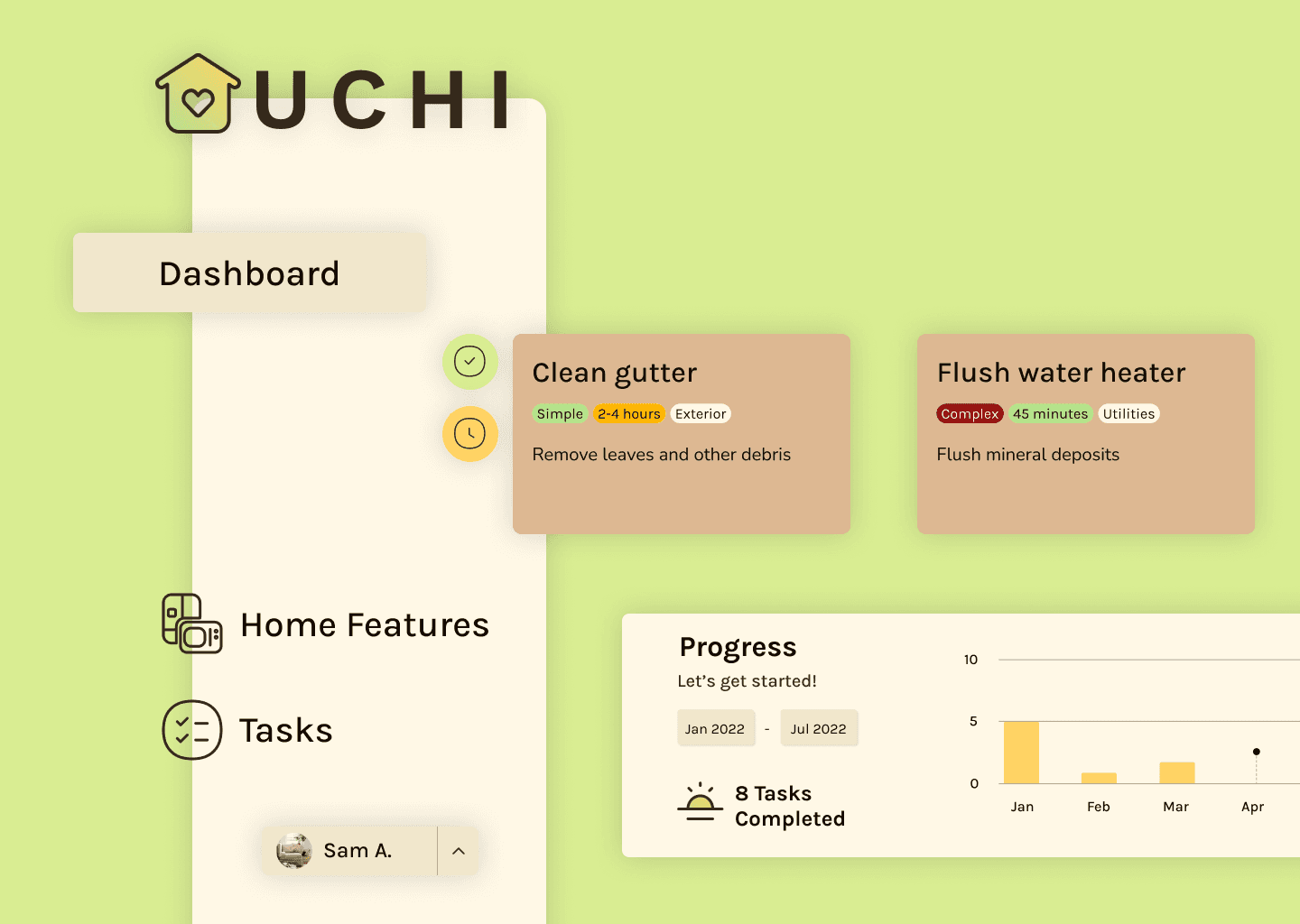
Users track their tasks primarily through the Dashboard, which surfaces upcoming maintenance by priority. Clicking into any task reveals a step-by-step guide and explains why the task matters — addressing the education gap that existing tools largely ignored.
Design & Iteration
In a team of four, two of us were responsible for designing the app in Figma — myself and one other —covering the full visual system, branding, and the prototype used in usability testing.
Testing validated our appliance-onboarding flow: users found it approachable enough that they'd return to add more, and one participant noted it was easier to use than comparable software. A second core flow told a different story — an entire main page felt redundant alongside the Dashboard. One participant noted the Tasks page added little when the Dashboard already communicated what to do and by when. Rather than cutting it, we redistributed: the Dashboard surfaces time-sensitive priorities, while the Tasks page became the complete browsable record. Redistributing Dashboard elements across the app also drove broader design consistency.
Participants averaged 4.5 pain points per session in early testing. After several iteration sprints incorporating user feedback, that dropped to 1 pain point per session in final testing.


Click images to enlarge. (Upper left) Adding a Home Feature. (Upper right) The Dashboard after adding Home Features with upcoming Tasks. (Lower left) Our original and final designs of the Tasks page, for mobile and desktop respectively. (Lower right) Users can track individual Task progress on Task Details pages.
Result
Once designs were finalized, I solely developed the front-end of the live web application using the Next.js framework.
UCHI was selected as a finalist for the Innovation & Design Award at the 2022 UW iSchool Capstone Gala, chosen from 150+ teams. As part of the final selection, my team was interviewed by a panel of industry professionals. While we were not selected as the awardee, it was a rewarding experience to be recognized for our work and to be able to share it proudly.